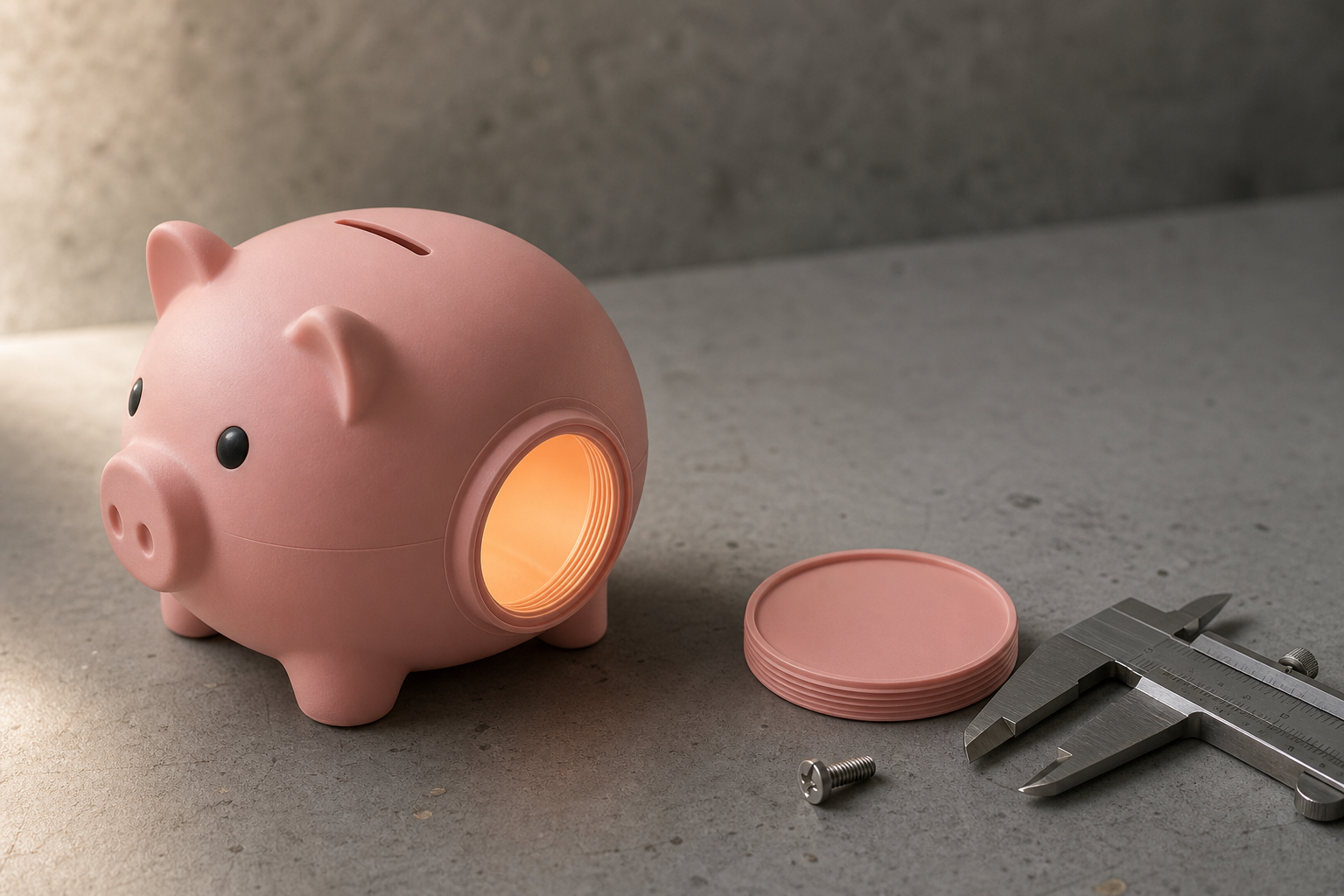
Three thousand pieces is where a lid stops being a detail
Our smallest run on the soft PVC light piggy bank family is 3,000 pieces, and that is also the run size at which a lid that fits badly stops being a detail and becomes a rework invoice. Buyers spend three weeks on the character: the eyes, the paint break, the moulded smile. Then they approve the lid in one line of email.
That’s backwards.
Who signs off on the part a child opens two hundred times? The same product gets listed as a coin bank in one market and a money saving box in another, and the lid does not care what the listing calls it.
Every load in the life of a coin bank lands on one seam
A lid carries three loads and the body carries none of them. The coin slot flexes every time a coin is pushed through, which is a fatigue problem wearing the costume of a strength problem. The seam takes the drop. And on a light-up version the same opening is also the battery door, so the fit has to survive a screwdriver and a nine-year-old in the same afternoon.
The lid does the work.
If you specify the body wall at 1.8 mm and leave the lid boss to the factory’s discretion, you have effectively outsourced the one dimension that decides whether the product comes back, because that boss sets grip, seal and battery-contact pressure at the same time. In the light piggy bank family that single part is doing night-light duty as well, which means the fit also decides whether the LED rattles.
0.25 mm of interference is a decision, not a tolerance
Take a rotocast vinyl lid with a 1.5 mm wall and a matching boss. At 0.25 mm interference the lid needs a firm pull, seats with an audible click and stays put through a metre drop onto tile. At 0.10 mm the same lid rattles loose after a few dozen cycles, and the retailer meets it before you do.
Too loose, it walks out. Too tight, nobody opens it.
Run the arithmetic on a 200-cycle life: 0.10 mm of interference against 0.02 mm of mould wear per 10,000 shots leaves you a joint that is already marginal at shot one and loose before the run is finished, while 0.25 mm still grips with 0.15 mm left in reserve. I would happily argue about a tenth of a millimetre on a drawing. Explaining a lid in the returns column is a worse conversation!
A lock changes the mould, not the bill of materials
A piggy bank with lock is not the same product with one extra component. The lock barrel sits under an undercut, the mould needs a slider, and the pull direction moves, which changes where the ejector pins leave their marks on a painted face. That is a tooling decision disguised as a hardware choice.
The lock and the coin slot are usually moulded as seperate inserts, and each insert is a wear item with its own tolerance drift, so a two-part closure that looks symmetrical on the drawing behaves very differently after 50,000 shots. Draft angle matters more than the lock: 1 degree on a 40 mm skirt is fine, 0.5 degree is a lid that fights the operator on the packing line.
If the shape is yours rather than ours, the OEM and ODM route is where the slider cost gets quoted properly instead of being absorbed into a unit price and forgotten.
What belongs on the lid drawing
Most lid arguments disappear once four numbers and three decisions are written down. A drawing that states only the outer diameter invites the factory to guess the rest.
| Field | State it as | Because |
|---|---|---|
| Interference | mm on diameter, min and max | Sets grip and seal; never leave it to “standard” |
| Boss wall | mm, with a minimum | Thin bosses crack at the slot, thick ones sink |
| Coin slot | width x length, with radius | Sharp corners tear on a vinyl skin |
| Retention | screw, bayonet, friction, tether | Decides service life and lab test route |
| Battery hatch | gasket material and compression % | The only moisture path on a light-up unit |
| Drop height | metres, onto which surface | The number the seam actually has to survive |
If the reply to “what interference are you running” is “standard”, walk. There is no standard. There is a number on a drawing or there is a sample that happened to work.
The lab grips the lid first
Test houses treat a removable lid as a component a child can grip, so under EN 71-1 and ASTM F963 it goes through tension and torque before anyone looks at the paint. CPSIA pulls the same part into the small-parts analysis for the US market. None of that is exotic, and none of it is optional for a coin bank sold to families.
The practical consequence is that a lid held by friction alone has to survive a pull that is well above the force a normal user applies, while a screwed or bayonet lid has to survive being opened repeatedly without the thread stripping. Both are testable. Only one of them is cheap to fix after tooling.
Numbers we will quote, and the one we won’t invent
Minimum order runs 3,000 pcs on the light family, production takes about 40 days from artwork approval, and new mould tooling runs US$600 to US$1,500 per mould depending on size and features. We quote FOB, DAP or DDP, and production sits inside a BSCI-audited factory.
What we will not do is print a test report number in a blog post. Every destination market’s lab issues its own, against its own sample, and a number copied from another buyer’s file is worse than no number. Ask for the report that matches your market and your artwork revision, and check the date on it.
One more gap worth naming: the 2026 catalogue carries item numbers and family material but does not print a size for every item, so sizes come back on quotation rather than from a table.
Four fields, one quote
Send the shape you have in mind, the age group it is aimed at, the quantity for the first run, and your target price per unit. Those four fields are enough to tell whether the lid should be friction, bayonet or screwed, and that answer moves the tooling cost far more than the character does.
Use the enquiry form and put the shape, age band, quantity and target price in the message. A photo of a competitor’s silhouette is fine as a reference for the shape only; we quote from our own moulds or from a drawing. Chibe answers quotes from the factory office, not from a call centre, so the interference number you get back is the one the tool room will run.
Chibe Toy Co., Ltd. — OEM and ODM soft PVC toys.
Email [email protected] if you would rather write directly, or send the shape, age band, quantity and target price through the enquiry form above.