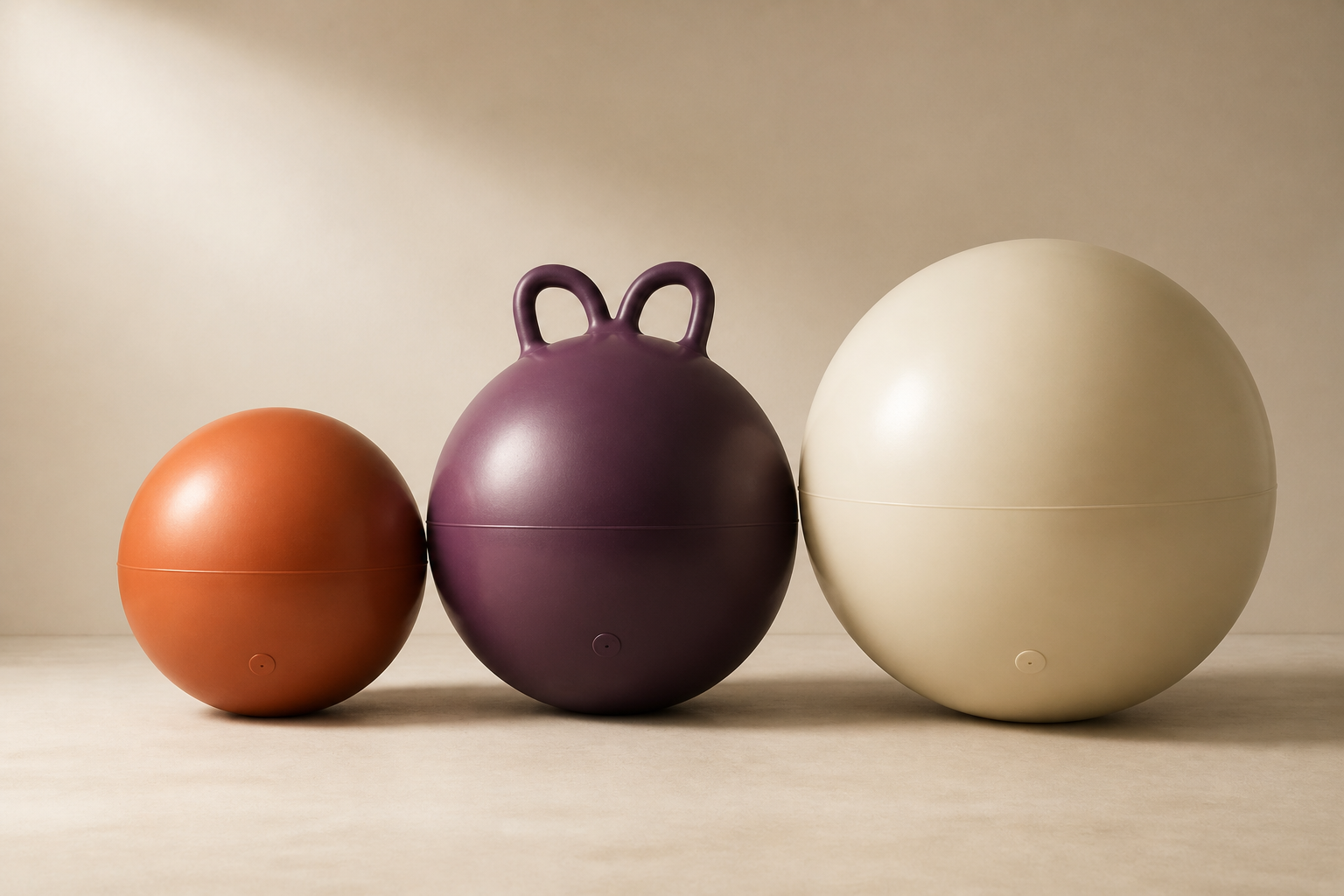
A 60 cm ball and a 100 cm ball are not the same product twice
Three diameters, three moulds, one carton family. Buyers treat size as a line on a purchase order — change the number, hold the unit price, ship — and the 80cm hopper ball that arrives is not the 60 cm version scaled up by a third, because a sphere does not scale that way at all.
Double the diameter and you quadruple the skin, while the pressure inside pushes on a bigger radius with every millimetre you add. Nobody re-checks the film gauge when the carton changes. That is why size arguments usually come back as complaints about seams instead of drawing revisions, three months after the container lands.
Size is a spec.
Two numbers decide what a bigger ball costs
Take a working example: a ball inflated to 0.3 bar, which is firm under a thumb without feeling like a tyre. The membrane stress in a thin PVC skin is proportional to radius over thickness, so at a fixed gauge the 100 cm ball carries 67% more stress than the 60 cm one before a single rider touches it, purely because the radius beneath the skin grew by two thirds.
Then count the skin itself. The surface of a sphere is πd², which gives 1.13 m² at 60 cm, 2.01 m² at 80 cm and 3.14 m² at 100 cm. Multiply that by the gauge you need in order to hold stress constant and the material bill runs roughly 1 : 2.4 : 4.6 across the three sizes, which means the largest ball consumes more than four times the film of the smallest, and that is not a cost curve any diameter-based price ladder survives.
That gap is where a size-up gets approved on a spreadsheet and quietly loses money in the moulding hall, and it is also why a 100cm hopper ball priced off the 80 cm quotation comes back with a thinner skin than the drawing asked for.
A 100 cm ball on 0.30 mm film is a returns queue with a valve on it!
Where each diameter actually sells
| Nominal size | Typical rider | Where it moves | What the drawing must carry |
|---|---|---|---|
| 60 cm | 3–5 years, 25 kg class | Gift, party and grocery channels; low ticket, fast turns | Gauge, weld width, valve seat, seat height under load |
| 80 cm | 5–8 years, 50 kg class | The core toy-retail and online volume size | Same as above plus a stated inflation pressure |
| 100 cm | 9 years and up, teen and adult novelty | Outdoor, sports and retro-gift buyers; one unit per household | Heavier gauge, wider weld, load rating printed on the carton |
Seat height is what the child feels, and it is not the diameter. Assume 20% deflection under a seated rider and the top of the ball drops from 60 to about 48 cm, from 80 to 64, and from 100 to 80 — enough that the smallest size is a feet-flat ride for a five-year-old and the largest leaves the same child dangling.
Who signs off on that when the buyer only approved a diameter?
Nobody does.
Nominal size is a tolerance, not a fact
A filled PVC ball is not a sphere. The pole-to-pole measurement typically reads 1–2 cm under the equator measurement on the same unit, and both numbers move with inflation pressure and with how long the film has been relaxing since it came off the pump. Write the spec as a measurement instruction or you will argue about it later: equator diameter at a stated pressure, read 24 hours after inflation, ±2 cm, with a minimum pole-to-pole figure. Measure it twice.
Retailers do measure. A ball that reads 78 cm out of an 80 cm carton is a customer-service ticket, and in a market where the size is printed large on the shelf-ready pack it is also a markdown.
The handle pulls on the same seam as the air
On an animal hopper the grip is usually a welded strap or a moulded ear, and every yank on it loads the weld that is also holding the air. That is one joint doing two jobs, so the weld schedule — frequency, pressure, dwell — matters more than the shape of the handle. This is also where the cheap version fails first, because widening a weld costs almost nothing in material and a great deal in cycle time.
The valve is the other joint worth writing into the spec, because a plug that sits proud of the skin gets dragged across a floor and starts weeping at the seat — the most common field complaint on inflatables, and the cheapest one to design out. If you are sizing an animal shape rather than a plain ball, the animal hopper range shows the shapes those welds have to survive.
State a pull force on the handle and a leak-down time on the valve. Both are testable in ten minutes, and neither is in most buyer specs.
Plasticizer limits follow the size you can legally sell
In a plasticized PVC ball the phthalate question arrives with the material, not with the market. Under CPSIA the eight restricted phthalates sit at 0.1% each for the US, EN 71-3 controls migration for the EU, and EN 71-1 and ASTM F963 treat the handle, the valve and the film thickness as mechanical risks rather than chemical ones. None of that gets easier at 100 cm, where a heavier rider turns a marginal weld into a tear.
Age grading has to match the size on the carton as well. A 100 cm ball labelled for three-year-olds invites a claim you will lose on the photograph alone.
One diameter per market is usually the right first order
Most first orders should carry a single size, and for most markets that size is the 80 cm, because it is the one a retailer can stack, a parent can carry and a warehouse can pallet without a special carton. The 60 cm earns its place as a basket builder and a party-program item, while the largest size lives on a different shelf altogether: the space hopper ball buyer is often an adult replacing a toy they had at eight, which is a completely different carton, price point and returns profile.
Split the tooling across three sizes in the same season and you will pay three mould amortisations to sell one and a half products, which is how most of these range extensions have occured. If the shape is new rather than a size of an existing mould, the OEM and ODM route is where that tooling number belongs, quoted once instead of absorbed into a unit price nobody can unpick later.
What to send us instead of a carton reference
Four fields get you a real quote: the shape you want, the age band it is aimed at, the quantity for the first run, and your target price per unit. Those four tell us whether the ball should be a 0.30 mm skin at 60 cm or a heavier gauge at 100, and the gauge decision is the one that moves both the tooling and the freight.
Put them in the enquiry form and we will answer with the size we would actually run for that brief, not the size in the catalogue that happens to be closest. A photograph of a competitor’s silhouette is fine as a shape reference; we quote from our own moulds or from a drawing, which is also why the answer arrives with a gauge and a weld width attached.
Chibe prices the size you need, not the size that fits the shelf.
Chibe Toy Co., Ltd. — OEM and ODM soft PVC toys.
Email [email protected] if you would rather write directly, or send the shape, age band, quantity and target price through the enquiry form above.