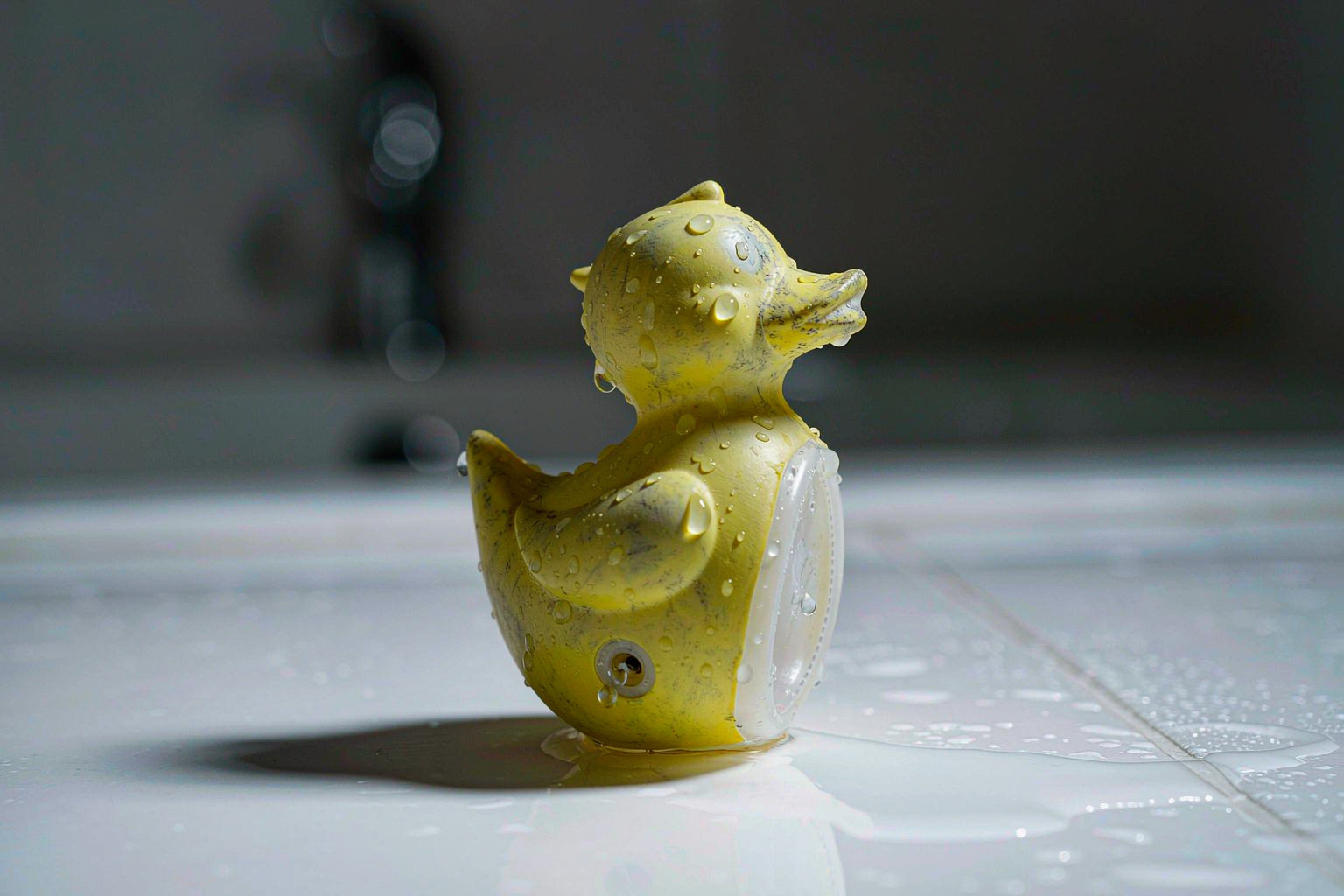
Eleven grams of water
Eleven grams. That is two teaspoons, and it is what drains out of a 90-gram vinyl duck that has spent one season in a bath every night — the toy looks perfect from the outside, still floats, still squeaks, and is quietly cultivating something inside a cavity nobody has opened since it left the mold. Most bath toys are built to pass a sample table, not a bathroom.
Water always gets in. Everyone in this trade knows it gets in, and the argument was never about whether it does, but about where the responsibility sits: with the toolmaker who cut the parting line, with the seal the buyer wrote into the spec, or with the line that closed the hatch at 90% of the specified gap because the shift was running behind and the supervisor was not going to stop the machine for a gasket.
So why does the sample always pass?
A cavity is a bottle
Hollow rotocast vinyl is a bottle without a neck. Squeeze the body and air leaves; release it and air returns, and whatever water was sitting against the squeaker hole goes back in with it — which is precisely how a reed squeaker works, and precisely why a reed squeaker is the first thing I pull out of a toy that smells wrong.
The physics is boring and unforgiving. A 30 ml cavity at bath temperature, sealed on all sides, does not dry. It incubates.
Four ways in, one of them invisible
A 6 mm squeaker hole is a door. On a light up bath toy the battery hatch is a larger door with worse manners. A solvent-glued seam is a crack waiting for the shell to flex, and it always flexes, because a hollow body under a child’s grip is a bellows.
Then there is the fourth one. Mold release. A thin film of release agent on the inside wall gives water something to cling to, so even a toy that drains by design keeps a residue it can never fully shed — and no incoming inspection on earth will find that, because it is not a defect, it is a process choice made three steps upstream of the sample you approved.
The number nobody asks about
Gasket compression. Ask a buyer what compression their seal runs at and you get a pause, then a sentence about “good quality silicone”, which is not a number and therefore not a specification.
Here is the comparison that actually decides the outcome. Take a 1.0 mm silicone gasket with a 0.7 mm shut gap — 30% compression, which is inside the normal working range for a soft 50–60 Shore A compound and will hold for thousands of closures. Now run the same gasket into a mold that was polished a little too aggressively, or shim the hatch 0.3 mm to fix a sink mark, and the gap becomes 0.4 mm. That is 60% compression. The gasket is not sealing anymore, it is extruding, and after a few hundred closures it takes a permanent set and the toy is a colander with a face on it.
That is not a gasket. That is a gap with good manners.
Put this on the PO
Words like “high quality” and “no mold” get you whatever the factory already runs. These lines change what comes off the line:
- Single-piece rotocast body, or two-piece with a mechanical joint plus gasket — state which, and name the gasket material and hardness.
- Battery compartment as a seperate sealed chamber on the dry side of the shell, with the closure cycle count stated.
- Squeaker: none on water-play SKUs. If sound is required, specify a sealed electronic module instead of a reed.
- Drain and vent positions drawn on the tooling print, not described in a paragraph.
- 100% air-pressure leak test with the reject rate reported per batch, not AQL sampling.
Leak testing at 100% sounds expensive until you price a return season. Nobody believes that number until it happens to them.
A bucket beats a lab
You do not need a chamber to catch this. Weigh the unit dry. Submerge it for 48 hours, squeezing and releasing it through the soak so the cavity breathes the way it will in a bathroom, then dry the surface and weigh again — anything above a 0.2 g gain has taken water, and the seam that failed is usually visible as a damp line once you cut the shell open.
Do the same test after 200 hatch closures. A seal that only works when it is new is not a seal, it is a promise.
Where the cheap toy wins
It wins on the quote. Nowhere else.
A glued seam with a reed squeaker is genuinely cheaper per unit than a gasketed, vented, sealed-electronics build, and I am not going to pretend otherwise — the difference is real and it sits in exactly the place a sourcing manager is measured on. But a recall, a marketplace suspension or one bad season of reviews costs more than the delta on the whole container, and it costs it in the year you were planning to launch the next range.
I think a glued seam on a water toy is a finance decision wearing an engineering costume. It is the wrong one, and the bill arrives in a different department than the one that saved the money!
If you want to see how the two constructions sit side by side, the bath toys we run are built both ways for different price bands, and the difference is visible in the tooling drawings rather than the brochure copy — have a look at the bath toys before you commit to a target cost.
Compliance is a different argument
Water ingress is a durability problem that turns into a compliance problem the moment it creates a hygiene, small-parts or electrical risk. EN 71-1 in the EU, ASTM F963 and CPSIA in the US — the standard names are easy, the clause that applies to a battery hatch on a bath toy is not, and that is a question for your testing lab rather than your supplier.
Which is the whole point. A supplier will tell you a construction is compliant, because the alternative is losing the order. Ask which standard, which clause, which lab, which report number and which date — and if the answer is a PDF from two years ago, treat it as the start of a conversation.
Chibe has been molding rotocast vinyl long enough to have shipped both constructions, and the ones that come back are never the ones with the gasket. The tools are on the main site if you want to compare the drawings yourself.
Send the shape, the age range, the quantity and your target price through the enquiry form on chibetoy.com, and you get a construction recommendation before a quotation — that order matters, because a price quoted against the wrong construction is a number you cannot use.
Chibe Toy Co., Ltd. — OEM and ODM soft PVC toys.
Email [email protected] if you would rather write directly, or send the shape, age band, quantity and target price through the enquiry form above.